
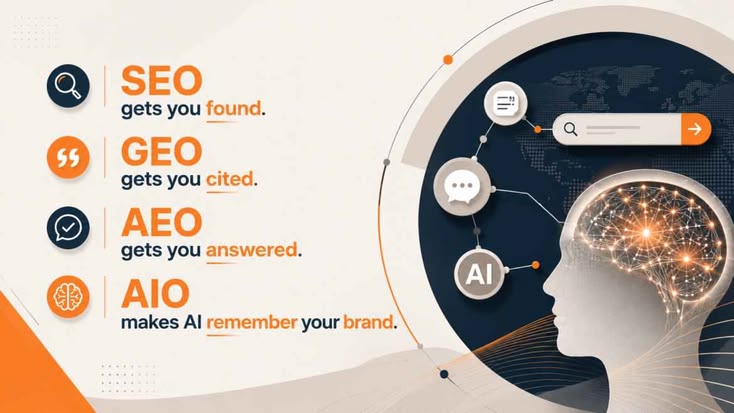
“SEO vs AEO vs GEO: what would be more used for businesses by sEO service Agency in Ahmedabad?”
SEO vs AEO vs GEO in 2026: What Should Businesses Optimize for Now?
Search is changing faster than ever.
A few years ago, the typical customer journey was simple: a person searched a keyword on Google, scanned the results, clicked a website and made a decision.
In 2026, that journey can look very different.
A customer might search Google and receive an AI Overview. They may continue the conversation in Google AI Mode, ask a question through ChatGPT Search, compare several businesses through an AI-generated response, or use conversational queries instead of traditional keywords.
This change has created three terms that marketers and business owners increasingly hear:
SEO — Search Engine Optimization
AEO — Answer Engine Optimization
GEO — Generative Engine Optimization
But are SEO, AEO and GEO actually three completely different marketing strategies?
Not exactly.
The better way to understand them is as different approaches to the same larger objective: making your business discoverable, understandable, trustworthy and useful wherever people search for information.
Google’s current guidance is particularly important here. Google states that SEO best practices remain relevant to AI features such as AI Overviews and AI Mode. It also explains that AEO and GEO are terms commonly used to describe optimization for AI search experiences rather than completely separate systems from SEO.
So, what should businesses want to grow in 2026?
The answer is:
Don’t choose SEO over AEO or GEO. Build a strong SEO foundation and expand it for answer-driven and generative search experiences.
Let’s understand how.
What Is SEO?
SEO, or Search Engine Optimization, is the process of improving a website so that search engines can discover, understand, evaluate and rank its content for relevant searches.
Traditional SEO focuses on helping your pages appear prominently in search results when potential customers search for information, products or services.
SEO includes several major areas:
- Keyword and search-intent research
- Technical SEO
- On-page SEO
- Content optimization
- Internal linking
- Website designing
- Page experience
- Local SEO
- Image and video optimization
- Structured data
- Authority and reputation
- Helpful, original content
For example, a digital marketing agency in Ahmedabad might create a service page targeting searches such as:
“digital marketing agency in Ahmedabad“
But modern SEO is not simply about repeating that exact phrase.
A strong page should also answer related questions:
- What does a digital marketing agency do?
- Which services are included?
- How can digital marketing generate leads?
- How much does digital marketing cost?
- Which strategy is suitable for small businesses?
- How can businesses measure marketing ROI?
- What makes one agency different from another?
This is where modern SEO starts overlapping with AEO and GEO.
What Is AEO?
AEO, or Answer Engine Optimization, focuses on making content easy for search engines and answer engines to understand and use when providing direct answers to users.
Traditional search often revolves around:
“Which page ranks #1?”
AEO shifts some attention toward:
“Which source provides the clearest answer to this question?”
For example, someone may search:
“What is technical SEO?”
Instead of browsing ten pages, the user may receive a direct answer in a search feature or AI-generated response.
This means businesses need content that provides clear, accurate and context-rich answers.
AEO strategies commonly include:
- Question-based headings
- Direct answers
- Concise definitions
- FAQ sections
- Clear content structure
- Semantic topic coverage
- Natural language
- Search-intent alignment
- Supporting evidence
- Author expertise
- Strong internal linking
For example:
What is AEO?
AEO is the process of structuring and improving online content so that it can provide clear, relevant answers to users’ questions across modern search and answer-driven experiences.
That format is easy for a human to understand and easy for search systems to interpret.
However, AEO is not about writing robotic answers solely for machines.
The ultimate audience remains the human user.
What Is GEO?
GEO, or Generative Engine Optimization, refers to efforts aimed at improving a brand’s visibility and representation within generative AI search experiences.
Generative search can synthesize information from multiple sources and produce an answer instead of simply presenting a traditional list of blue links.
Examples of generative search experiences include:
- Google AI Overviews
- Google AI Mode
- ChatGPT Search
- Other AI-powered discovery experiences
OpenAI’s ChatGPT Search, for example, can search the web and provide users with timely answers accompanied by relevant web sources.
Google’s AI Search ecosystem has also expanded significantly. Google reported in 2026 that AI Overviews had more than 2.5 billion monthly active users and AI Mode had surpassed one billion monthly users globally.
That means businesses increasingly need to think beyond:
“Can people find my website?”
They also need to consider:
“Can AI systems understand my business accurately enough to mention or cite it when relevant?”
SEO vs AEO vs GEO: What Is the Difference?
The simplest distinction is:
| Strategy | Main Focus | Typical Goal |
|---|---|---|
| SEO | Search visibility | Rank and attract organic traffic |
| AEO | Direct answers | Become a useful answer source |
| GEO | Generative AI visibility | Increase visibility in AI-generated responses |
But these strategies overlap heavily.
SEO asks:
How can my website become more visible in search results?
AEO asks:
How can my content clearly answer the questions users are asking?
GEO asks:
How can my brand and content become useful, understandable and credible enough to be surfaced by generative search systems?
The important point is that these aren’t isolated marketing channels.
They form a connected search visibility ecosystem.
SEO vs AEO vs GEO: Which One Is More Important in 2026? Which will be more useful for best digital marketing agency?
For most businesses, the answer is:
SEO first, AEO and GEO as extensions.
Why?
Because AI search still relies heavily on discoverable, crawlable and useful web content.
Google’s official documentation states that pages need to meet the normal technical requirements for Google Search to be eligible as supporting links in AI Overviews or AI Mode. Google also says there are no special AI files or special schema requirements that guarantee inclusion.
Google’s 2026 guidance goes even further: generative AI features use information retrieved from Google’s Search index, including through approaches such as retrieval-augmented generation and query fan-out.
Therefore, abandoning SEO because “AI search has replaced Google” would be a mistake.
Instead, businesses should evolve their SEO strategy.
Yes. SEO still matters in 2026.
In fact, strong SEO is one of the foundations of AI-search visibility.
Google specifically confirms that existing SEO best practices remain relevant for AI Overviews and AI Mode.
This includes fundamentals such as:
- Allowing search engines to crawl important pages
- Building useful internal links
- Creating helpful, reliable content
- Maintaining good page experience
- Making important information available in text
- Using appropriate structured data
- Keeping business information accurate
- Avoiding unnecessary duplicate content
The important shift is not from SEO to GEO.
SEO is not dead. AEO is not a replacement for SEO. GEO is not a magic shortcut to AI visibility.
The search landscape is evolving from traditional keyword-based discovery toward a more conversational, contextual and generative experience.
Businesses that succeed in 2026 will be the ones that understand this shift without abandoning the fundamentals.
Build a website that search engines can access.
Create content people genuinely need.
Answer questions clearly.
Demonstrate real expertise.
Build a recognizable and trustworthy brand.
Connect related topics through a strong content architecture.
And make every important page useful enough that both people and modern search systems can understand its value.
The future isn’t SEO vs AEO vs GEO.
The future is SEO + AEO + GEO working together as one complete search visibility strategy.
F.A.Q.s
Yes. Google states that its existing SEO best practices remain relevant for AI Overviews and AI Mode. Strong technical SEO, useful content, crawlability and search visibility remain important foundations.
No. AEO is better viewed as an extension of modern SEO that emphasizes direct answers, questions and conversational search intent.
GEO is not a single Google ranking factor. It is a broader industry term for efforts to improve visibility in generative AI experiences. Google describes AEO and GEO as terms used for optimizing visibility in AI search while emphasizing that foundational SEO remains important.
Start with strong SEO fundamentals, publish original and helpful content, answer customer questions clearly, demonstrate expertise, strengthen your brand entity, improve internal linking and maintain accurate business information.
Yes, but keyword research should be combined with search-intent research, topic relationships, conversational queries and customer questions.
The important issue is not simply whether AI was involved in producing content. Content should provide genuine value, be accurate, original where appropriate and created for people rather than primarily to manipulate search rankings.